Dumbbell Reverse Lunge Exercise 💪
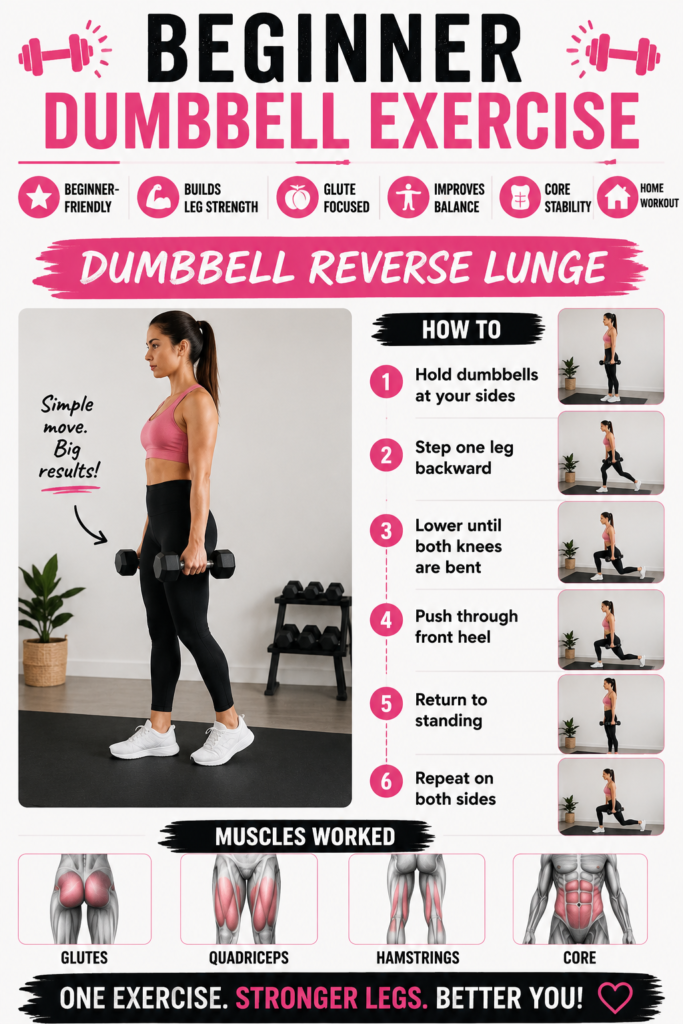
A Great Beginner Dumbbell Exercise for Stronger Legs, Better Balance & Glute Development
If you’re new to strength training and looking for an exercise that builds lower-body strength while improving balance and coordination, the Dumbbell Reverse Lunge is a great exercise to start with.
Unlike many beginner exercises, the reverse lunge trains multiple muscle groups at the same time while teaching proper movement patterns. It’s simple to learn, requires minimal equipment, and can be performed almost anywhere.
Whether your goal is to build stronger legs, tone your glutes, improve balance, or simply become more confident with dumbbells, this exercise deserves a place in your workout routine.
Why Beginners Should Learn the Dumbbell Reverse Lunge
Many people immediately think of squats when they start strength training. While squats are excellent, reverse lunges offer several unique advantages for beginners.
Benefits
- Beginner-Friendly
- Builds Leg Strength
- Glute Focused
- Improves Balance
- Core Stability
- Home Workout Friendly
Because each leg works independently, reverse lunges help develop strength evenly while also challenging stability and coordination.
Muscles Worked
The Dumbbell Reverse Lunge is a highly effective compound exercise that targets multiple muscle groups simultaneously.
Glutes
Your glutes help drive you back to the starting position and play a major role in lower-body strength.
Quadriceps
The front of your thighs works hard during the lowering and standing phases of the movement.
Hamstrings
The hamstrings help stabilize the movement while supporting hip extension.
Core
Your abdominal muscles and deeper core stabilizers work throughout the exercise to keep your body balanced and upright.
How to Perform a Dumbbell Reverse Lunge
Follow these simple steps.
Step 1
Hold dumbbells at your sides.
Stand tall with your feet hip-width apart.
Step 2
Step one leg backward.
Take a controlled step behind your body while keeping your torso upright.
Step 3
Lower until both knees are bent.
Your front knee should remain aligned with your foot.
Step 4
Push through your front heel.
Drive through the front foot to begin returning to the starting position.
Step 5
Return to standing.
Bring your back foot forward and stand tall.
Step 6
Repeat on both sides.
Perform the same number of repetitions for each leg.
Common Beginner Mistakes
Leaning Forward
Many beginners lean excessively forward during the movement.
Instead:
- Keep your chest up
- Look straight ahead
- Maintain a neutral spine
Taking Too Small of a Step
A short step can place unnecessary stress on the knees.
Instead:
- Step far enough back to comfortably lower both knees
Pushing Off the Back Leg
The goal is to drive through the front heel.
Focus on:
- Front leg strength
- Controlled movement
- Proper balance
Moving Too Fast
Beginners often rush the exercise.
A slower tempo improves:
- Balance
- Muscle activation
- Technique
Why Reverse Lunges Are Great for Women
Reverse lunges are one of the most popular lower-body exercises because they target areas many women want to strengthen.
Glute Development
The movement strongly engages the glutes while also improving overall lower-body strength.
Leg Strength
Reverse lunges challenge the quadriceps and hamstrings through a full range of motion.
Improved Stability
Because you’re working one side at a time, the exercise develops balance and coordination.
Functional Fitness
The movement pattern carries over well to everyday activities such as walking, climbing stairs, and sports.
Beginner Workout Example
You can include the Dumbbell Reverse Lunge in a simple beginner workout.
Beginner Lower Body Routine
- Goblet Squat – 3 sets
- Dumbbell Reverse Lunge – 3 sets
- Glute Bridge – 3 sets
- Dumbbell Romanian Deadlift – 3 sets
Rest 60–90 seconds between sets.
How Many Reps Should Beginners Do?
Option 1: Learning Phase
- 2–3 sets
- 8 repetitions per leg
Focus on technique.
Option 2: Building Strength
- 3 sets
- 10–12 repetitions per leg
Use a weight that challenges you while maintaining good form.
Option 3: Endurance & Conditioning
- 3 sets
- 12–15 repetitions per leg
Maintain controlled movement throughout each set.
Tips for Better Results
Start Light
Choose a weight that allows you to focus on form.
Control the Descent
Lower yourself slowly rather than dropping into the lunge.
Keep Your Core Tight
Core engagement improves stability and balance.
Be Consistent
Performing this exercise regularly will lead to better results than constantly switching exercises.
Final Thoughts
The Dumbbell Reverse Lunge is a great beginner dumbbell exercises because it combines strength, balance, coordination, and muscle development in one simple movement.
By targeting the glutes, quadriceps, hamstrings, and core, this exercise helps build a stronger lower body while remaining beginner-friendly and easy to perform at home or in the gym.
If you’re just starting your fitness journey, mastering the Dumbbell Reverse Lunge is an excellent step toward stronger legs, better balance, and greater confidence with dumbbell training.